

YESTERYEAR Review
No one likes a mad woman.

I cried for hours after seeing the Barbie movie. I remember the sense of despair and anger I felt after; the utter disbelief and disappointment that most women, if not all, have the same lived experience of never feeling good enough. Before that, I remember being frustrated hearing people say Hillary Clinton was too frigid to be President, and then me asking why she had to be warm to do her job. I’ve had off-hand comments made about me not being a good cook or good housemaker, and if I’ve challenged those comments, I’m sensitive or I can’t take a joke, all the while those commenters never compliment my ability to be successful at my job, a first gen college graduate, or I don’t know, overall a human being with other qualities than being a bad housemaker. I’ve struggled with my role as a woman, never quite knowing how to be; the balance of being likeable but not too likeable, pretty but not overly pretty, desirable but not to the point of leading a man to sin. So many versions of us that we, as women, are forced to be and seamlessly switch out of.
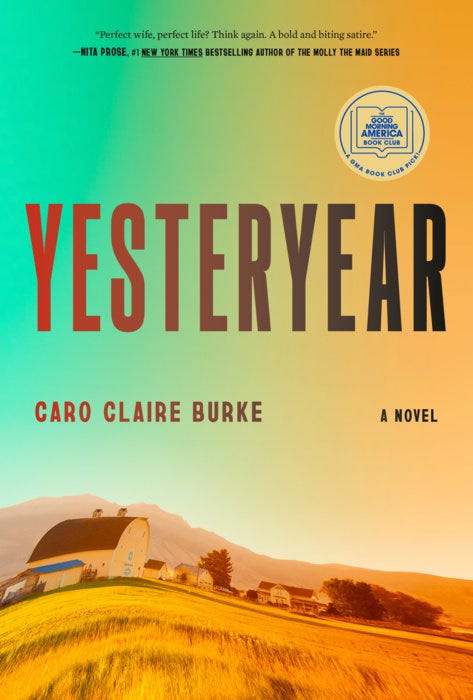
All of these things and more came to mind while reading Caro Claire Burke’s YESTERYEAR. There are at least 4 fictional novels about “tradwives” coming out in 2026, and to me, it’s obvious why. We are living in a weird time as a society; we should be moving forward, advancing, and in some areas, we are, but at the same time, we are also stepping back. And I think that’s what makes YESTERYEAR, a book that should be more fiction than it is horror, so scary. The events in this book should seem absurd, but instead they feel real.
In YESTERYEAR, Burke introduces us to Natalie Heller Mills, a “tradwife” influencer who wakes up in 1855. Natalie has no idea how she ended up there; is she in a nightmare, or is this a reality show? Her husband, her children, and her home seem like hers, but something about each is not quite the way it should be.
Admittedly, I had no idea where Burke was going with YESTERYEAR until the end, but the writing is sharp, engaging, and often funny, so I was happy to be along for the ride. We can picture the world and the characters in YESTERYEAR because of the care and detail Burke has put into telling this story. Burke has created a story that feels ripped from the headlines; at times, while reading YESTERYEAR, I felt as though I was reading a true crime story. Natalie’s family and her in-laws are the people we see on television and know in real life; they are the politicians we see on the news, they are the protestors being interviewed and denouncing vaccines and banning books.
Burke keeps us suspended and wondering what’s next in YESTERYEAR, mostly through the novel’s structure. Told in parts and then flashbacks within the parts, YESTERYEAR often feels like a fever dream. As readers, we are going through what is happening as blindly as Natalie is, and it’s a highly effective device that Burke has employed. This also leads to more questions, like if Natalie is an unreliable narrator. Can we trust what she is telling us? I’ve finished the book, and I’m not entirely sure. Burke counteracts this with other characters, outsiders who are brought in purposefully, who challenge Natalie and her lifestyle.
One question that I kept asking myself through YESTERYEAR is “Would Natalie be who she is without the influence of those in her life?” It’s a question we often ask, right? Who a person would be without the influence of their parents, the influence of the society and community (or lack thereof) that they are brought up in. I tend to think that Natalie is a product of her environment, and I think that’s what makes the situation she finds herself in so much more tragic. But yet, Natalie is not quite fully redeemable. Trauma and abuse are cyclical, and eventually someone has to break the cycle, and Natalie doesn’t.
But, Natalie isn’t alone in her decisions. And that brings me back to my opening paragraph. I’ve seen a lot of reviews call Natalie unlikable, but with no explanation. It reminds me of the conversations I saw online around Ursula from Josh Malerman’s INCIDENTS AROUND THE HOUSE. In INCIDENTS AROUND THE HOUSE, Ursula doesn’t possess the traditional qualities we expect of mothers; she isn’t the best mom (but she isn’t the worst), and maybe she’s not the ideal partner. She isn’t perfect, but neither is her husband, Russ, and yet, only Ursula draws ire and criticism from readers in a way that feels like misplaced anger at best and sexism at worst. I feel the same way about Natalie. Caleb is pretty useless; he has no motivation, isn’t that smart, is selfish, a bad husband, and not a great dad, but I haven’t seen any reviewers really call Caleb to the mat the same way they have Natalie. The situation that Natalie finds herself in is in part due to Caleb’s behavior, but she is the only one facing any true consequences. Why? Is it because we expect so little from men, both in real life and in fiction, that we don’t expect even the bare minimum from them? Much like Ursula, I didn’t actually find Natalie unlikable. Would I be friends with Natalie? Probably not, but I didn’t walk away from YESTERYEAR hating her. Do I think her behavior at times was abhorrent, and her children deserve better? Of course. But Caleb and his dad are the ones that I found unlikable, not Natalie.
Which makes me wonder if that is part of Burke’s point in YESTERYEAR? Natalie is consistently trying to please everyone in her life; she is trying to be a good wife, a good mother, and, in a weird way, a good influencer. She’s completely lost herself, and the versions of her that she discovers never feel authentic because she doesn’t know who she is supposed to be. Meanwhile, Caleb never even has to question who he is; he quite literally has never thought about what he wants to be when he grows up. I think most women have felt like Natalie at some point. I know I have. I think we’ve all looked in the mirror and thought I made a mistake. We’ve all thought this isn’t what I signed up for, or this isn’t what I was promised. And what do we do with that? What will we risk, what will we sacrifice to make it better? To grin and bear it? Are we selfish for putting ourselves first? Maybe sometimes, and if so, is that a bad example or a good example for our children? It’s complex, and YESTERYEAR draws on that complexity and leaves us with so much to think about.
[YESTERYEAR is out now. Thank you to the publisher for my advance copy of the book.]
Sold! I love this breakdown. Were you a psych major in undergrad? Just curious as you’ve got a very good grasp. 💙
You kill me with these reviews, books I wouldnt have thought I'd like and now I need 😅